Главная
Блог
Taking Orders Through a Telegram Bot in Distribution: B2B Processes, Technical Requirements and Sales Doctor Solutions
Taking Orders Through a Telegram Bot in Distribution: B2B Processes, Technical Requirements and Sales Doctor Solutions
Кейсы

TL;DR: Taking orders through a Telegram bot in distribution replaces chaotic group chats, phone calls and paperwork and connects the sales point directly to the distributor's warehouse and accounting system. A B2B bot differs from an ordinary retail bot through closed access, individual prices, bonuses, debt limits and reconciliation statements. Sales Doctor splits the process across 3 bots ("Orders", "Reconciliation", "Scheduled report"): when an order reaches the server, warehouse stock and the debt limit are checked automatically. The article includes screenshots, a video, 10 technical requirements, KPI formulas and 5 implementation steps.
Table of contents
What losses occur in distribution when orders are taken manually?
How does a B2B distribution bot differ from an ordinary retail (B2C) store bot?
How Telegram bots work in the Sales Doctor ecosystem: 3 specialized bots and a 4-stage process
10 technical and business functions a distribution bot must have
Comparing distribution solutions in Uzbekistan and custom bots
Measuring distribution performance: 4 core KPI formulas
Steps to launch a Telegram ordering bot without stopping sales
In Uzbekistan, more than 25 million people use Telegram every day, and over 85% of the internet audience is on the messenger. Retail points, pharmacies and HoReCa venues still write their orders to distributors in the messenger. Taking orders through a Telegram bot in distribution acts as a B2B channel that replaces chaotic group chats, phone calls and paperwork and connects the sales point directly to the distributor's warehouse and accounting system (Sales Doctor).
💡 Key point: distribution needs not a retail-store bot but a closed B2B bot that knows the price type, bonuses, debt limit and warehouse stock.
What losses occur in distribution when orders are taken manually?
When orders from sales points are taken by phone, WhatsApp or ordinary Telegram groups, a break occurs at every link of the supply chain. According to Sales Doctor analysis based on the experience of more than 2,000 companies, the following systemic problems appear when order taking is not automated:
Double manual entry and paperwork: the operator reads the list the customer wrote, manually checks the range, contract price, warehouse stock and accounts receivable, and re-enters the items into the accounting system.
Goods that are out of stock or close to expiry: a sales agent or operator promises goods without seeing the free stock in real time; as a result the order shrinks at the picking stage, and stock and returns slip out of control.
Dependence on an agent's visit: when goods run out, the store owner has to wait for the sales representative to arrive along the route, and information about new promotions and bonuses depends on whether the agent manages to reach every point.
Growth of overdue receivables: if a customer's debt limit and payment term are not checked automatically when the order is taken, shipments to debtors continue and cash turnover slows down.
In practice, distributors that systematized orders and warehouse control through Sales Doctor speed up delivery by up to 25% and cut warehouse costs by up to 31%. In addition, taking orders through a Telegram bot reduces operator costs by up to 50% and total operating costs by 35%, and triples the order processing speed.

How does a B2B distribution bot differ from an ordinary retail (B2C) store bot?
Many developers offer an ordinary restaurant or online-store bot for distribution. In wholesale and distribution, however, B2C bots do not work. There are sharp architectural differences between retail bots (restaurant bots, online-store bots or order bots connected to a retail cash register system) and B2B distribution systems such as Sales Doctor:
Criterion | Ordinary retail bot (B2C) | Distribution ordering bot (B2B) |
|---|---|---|
Access rights | Open — any user who presses /start gets in | Closed — only a sales point, dealer or contract customer registered in the database |
Pricing policy | A single retail price for all buyers | Individual prices tied to the customer category (wholesale, store, HoReCa, dealer) and contract |
Promotions and bonuses | A simple promo code or single discount | A "5+1" goods bonus, volume discount, range bonus and automatic bonus accounting |
Financial control | Prepayment via Click/Payme or cash on receipt | Receivables control, overdue debt alerts, credit limit and consignment |
Units of measure | Piece or portion | Block, box, pallet, minimum batch quota and instant reservation of warehouse stock |
Document exchange | A simple electronic receipt | A real-time "reconciliation statement" (Akt Sverka), waybill, Didox invoice and Asl Belgisi labeling |

How Telegram bots work in the Sales Doctor ecosystem: 3 specialized bots and a 4-stage process
Loading every distribution task onto one ordinary bot leads to a jam of messages. That is why in the Sales Doctor platform the processes are split across 3 separate Telegram bots:
"Orders" bot: grouping goods with a web app (WebApp), automated order intake from the electronic catalog, sending important notifications and tracking order status.
"Reconciliation" (Akt Sverka) bot: a financial communication tool between the distributor and the sales point, working in Uzbek and Russian. It sends real-time push notifications about orders, payments, bonus accounting and debt.
"Scheduled report" bot: a bot that automatically sends managers and supervisors, in several Telegram groups, sales volume, product share, sales team indicators, warehouse/branch reports and alert signals.

Sales Doctor Telegram bots: "Orders", "Reconciliation" and "Scheduled report" (an example of the interface on a test account; the screenshots show the Russian-language interface).
Taking an order from a sales point happens in 4 stages:
1. Identifying the customer and opening the WebApp catalog
When a sales point connects to the bot, the system recognizes it by its tax ID (TIN) or phone number. If the catalog has hundreds of SKUs and filters, a web app (Telegram Mini App / WebApp) opens instead of ordinary buttons, and goods are shown grouped, with pictures, individual prices and bonus terms.
2. Building the cart and automatically calculating discounts and bonuses
The store manager picks the items needed. The system itself calculates promotions such as "5+1", volume and range bonuses and the minimum order amount without errors.
3. Checking warehouse stock and the debt limit
The second the customer sends the order, the server (within 100–500 milliseconds) checks three conditions:
Warehouse stock and reserve: the availability of the chosen goods in the assigned warehouse is checked and they are reserved immediately.
Receivables and limit: the system checks whether the customer has overdue debt; if the limit is exceeded, it gives a warning or restricts the shipment.
Working hours and delivery area: the order acceptance time (for example, 10:00–22:00) and geolocation conditions are checked.
4. Delivery, returns control and the "Reconciliation" statement
The confirmed order goes to the warehouse for picking and to the forwarder's route sheet. The customer follows the order status through Telegram, and once the goods are delivered and payment is received, sees the updated balance and bonus accounting in the "Reconciliation" bot. This is how the dairy producer "Lattico", the motor oil distributor "Kixx" (GS Oil), and the companies "Alviero" (Olivia brand) and "Yupqa Lavash" brought the electronic catalog, returns control, Telegram bot and warehouse accounting into a single system.
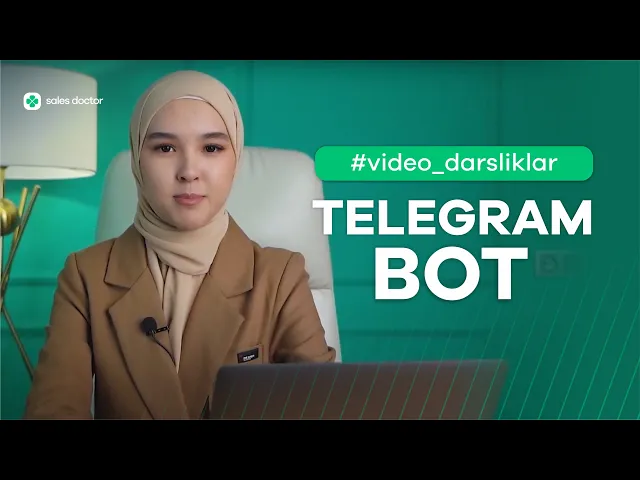
You can see how to use the "Reconciliation" bot in practice in the video below (the video is in Uzbek):

10 technical and business functions a distribution bot must have
For an ordering bot to work without interruption at a distribution company, the following technical requirements must be met:
Fast integration with CRM, ERP and 1C: stock, cash registers and debt must be kept in a single database. If both the bot and 1C keep stock separately, the numbers will differ after a month.
Real-time goods reservation: as soon as an order arrives, the goods must be reserved in the warehouse so that sales agents don't write already sold goods to another point.
One-button stop list and expiry control: items that have run out in the warehouse must close automatically, while products nearing expiry must be under control.
Debt limits by customer and brand: automatic notification of overdue debts for each dealer or sales point and blocking shipments when the limit is exceeded.
Automatic "Reconciliation" and bonus accounting: the sales point can check the reconciliation statement, payment history and accumulated bonuses in the bot itself, without calling a manager.
Returns and exchange control: recording defective or expired goods with the reason and correctly returning them to warehouse accounting.
Integration with payment systems and e-document exchange (Didox, Asl Belgisi): cash, transfers, Click, Payme and Uzum Bank payments, plus links to electronic invoices (Didox) and digital labeling.
Accounting for Telegram API rate limits: Telegram limits bots to a maximum of 1 message per second in a single chat and a maximum of 20 messages per minute to a group. So that messages are not blocked at peak hours, orders, reconciliation and group reports must be split into separate bot flows, as Sales Doctor does.
Demand forecasting and PIVOT reports: bringing all orders received from the bot and agents into a single PIVOT report, exporting to Excel and preventing stock shortages.
Bilingual interface and file exchange: working in Uzbek and Russian and transferring documents, certificates and shelf photos of up to 2 GB.

Comparing distribution solutions in Uzbekistan and custom bots
On the Uzbek market, distributors choose a Telegram ordering bot as a specialized DMS platform (Sales Doctor), as general accounting software, or as a program written from scratch to order:
System / solution | Main capabilities and scope | Payment model and timelines | Who is it for? |
|---|---|---|---|
A comprehensive distribution platform: 3 dedicated Telegram bots ("Orders" with WebApp, "Reconciliation" with push notifications, "Scheduled report"), an iOS/Android mobile app, warehouse and returns control, demand forecasting, a PIVOT report builder, 1C/ERP/CRM integration. Used by 2,000+ companies. | SaaS subscription (audit, servers in Europe and Russia, operator training and daily call center support are included) | FMCG, food, auto parts and wholesale distributors aiming to speed up delivery by up to 25% and cut warehouse costs by up to 31% | |
Other solutions | General ERP modules (sales, warehouse, CRM, finance, labeling), an order module connected to a retail cash register system (price type and warehouse selection, minimum amount, working-hours limit, geolocation), or a bot written from scratch to the company's own rules. 1C, Didox and Click/Payme connections are done separately, and the server and technical support are paid for separately. | A monthly subscription or one-time development: a simple bot 3–5 million UZS, a paid ordering bot 5–12 million UZS (from 10 days), an individual distribution program from 10 million UZS (in 14–28 days) | Enterprises that run stores, branches and production in one general ERP, networks of retail and wholesale stores, or companies with their own IT staff and non-standard processes that want a program written from scratch and kept on their own server |
Measuring distribution performance: 4 core KPI formulas
To see the results of the Telegram ordering bot and the sales agent team every day in PIVOT reports rather than at month-end, Sales Doctor analytics is built on the following 4 indicators (more on sales team KPIs in sales representative software):
Visit-to-order conversion: efficiency = (visits with an order ÷ total visits) × 100%. For example, if an order is taken at 21 of 30 points, the indicator is 70%. A Telegram bot lets sales points order on their own even on days the agent doesn't visit, increasing the total number of orders.
Average order value: average order = total order amount ÷ number of orders (for example, with 21 orders worth 31.5 million UZS, the average value is 1.5 million UZS). The WebApp catalog and automatic bonuses in the bot show the customer the whole range and raise the average order value.
AKB (active customer base): the number of sales points that placed at least one order in the selected period. A drop in AKB is the first warning signal that customers are leaving.
Share of overdue receivables: debt share = (overdue debt ÷ total customer debt) × 100%. When this indicator grows, notifications about overdue debts are sent automatically through the system and the "Reconciliation" bot, and shipments to debtors are restricted.
💡 In practice: orders that come in through the bot appear in the same PIVOT report as agents' orders, so channel performance can be compared on identical indicators.
Steps to launch a Telegram ordering bot without stopping sales
So that sales and warehouse work don't stop when switching to a new system in distribution, Sales Doctor practice carries out implementation in 5 proven steps:
Business and distribution audit: products (SKUs), units of measure, customer types, pricing policy and warehouse structure are studied, and duplicates are cleaned out.
Fixing opening stock and debts: on the cutover date, actual warehouse stock and each sales point's receivables are reconciled with accounting (1C) and loaded onto protected servers in Europe and Russia.
Training operators and the team: training on real data is held for operators, supervisors and warehouse staff under a dedicated training program.
Pilot (1–2 weeks): first, 2–3 sales agents and a group of active sales points connect to the Telegram bot (the "Orders" and "Reconciliation" bots), and price and promotion calculation is checked.
Full launch and ongoing support: all sales points are moved to the bot, the "Scheduled report" bot is configured for management, and the process is kept under constant control through daily call center technical support.

To see the bot on your own company's processes, sign up for a free 30-minute online demo or contact our team. Also read about controlling a team of agents: sales agent control app.
📞 Phone: +998 55 500 03 05 · ✉️ info@salesdoc.io · 📍 20A, 12th Neighborhood, Yunusabad District, Tashkent, Uzbekistan · 🌐 Request a demo · All contacts
Поделиться статьей:
© 2026 Все права защищены